Saturday, April 11, 2026
Your Team Is Ready for AI. Your Data Isn't.
Your Team Is Ready for AI. Your Data Isn't.
"AI readiness" gets discussed as though the hard part is convincing people. It isn't. We've assessed organisations where the entire leadership team was already using AI independently, paying for their own subscriptions, building their own automations. The appetite was not the issue.
The appetite was universal. The data readiness score across that same group: not quite 3 out of 5.
The team was ready. The systems were not.
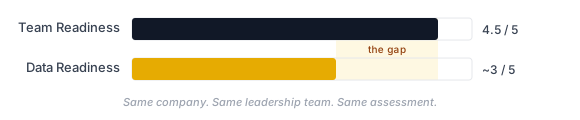
This pattern is everywhere. People assume "AI readiness" means willingness, training, change management. Those matter, but they're rarely the bottleneck. The bottleneck is context: whether it exists, whether it's accurate, whether you can get to it programmatically, and whether the things people know are actually written down anywhere.
The Readiness Gap Nobody Talks About
Industry data backs this up. Gartner found that 63% of organisations either lack or are unsure they have the right data management practices for AI. Their prediction: through 2026, organisations will abandon 60% of AI projects that lack AI-ready data. Not because the models are bad. Not because the teams don't want it. Because the data underneath isn't there.
A Lucid survey found that only 16% of respondents say their workflows are extremely well-documented. 46% say employees rely on tribal or institutional knowledge "sometimes," with another 31% saying "often or always." That knowledge is invisible to AI. It might as well not exist.
And the perception gap is striking. Precisely and Drexel University's 2026 State of Data Integrity study found that 88% of senior data leaders expressed confidence in their data readiness for AI, while 43% of those same respondents cited data readiness as their biggest obstacle to AI alignment. Both things were true, just about different parts of the problem. They had data. They didn't have AI-ready data.
Five Foundations of Data Readiness
When we assess a company's data readiness, it breaks down into five areas. All five need to be functional (not perfect, functional) before AI integrations start delivering reliable results.
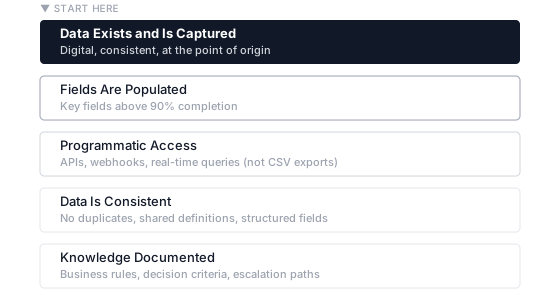
Data Exists and Is Captured
This sounds obvious, but it fails more often than you'd expect. Most companies have data. The issue is whether the data that matters is being captured digitally, consistently, at the point of origin.
Common failures: paper-based processes for stock receipt and delivery verification. Phone calls and verbal agreements that never get logged. Client interactions tracked in someone's memory but not in the CRM. Entire workflows that happen off-system because the system is too slow or too rigid.
If the data isn't captured, AI has nothing to work with. No amount of model sophistication compensates for missing inputs.
Fields Are Actually Populated
Having a database with the right schema is not the same as having data. We regularly see systems where the fields exist but 30-60% are empty. Contact records without email addresses. Job records without completion dates. Inventory entries without supplier codes.
These gaps are invisible in day-to-day work because people compensate. They know the supplier, they remember the completion date, they have the email somewhere in their inbox. AI doesn't have that context. It sees what's in the record, and if the record is half-empty, the output is half-useful.
Data Is Accessible Programmatically
This is the one that catches most small and mid-sized businesses off guard. You might have excellent data in your core platform, but if the only way to get it out is a manual CSV export, AI can't reach it in real time.
The questions that matter: Does your platform have an API? Is that API accessible on your pricing tier? (Many vendors lock API access behind enterprise plans. They know exactly what they're doing.) Can you query individual records, or only pull bulk exports? Is there webhook support for events?
A company with great data locked behind a manual export button is, for AI purposes, in roughly the same position as a company with no data at all. The data exists. It just can't participate in an automated workflow.
Data Is Consistent and Trustworthy
Duplicate records. Conflicting statuses. Fields that mean different things to different teams. Date formats that vary by who entered them. Free-text fields where structured data should be.
AI models process whatever you give them with total confidence. They don't flag that the same customer appears three times with slightly different names. They don't notice that "completed" in one department means something different from "completed" in another. They produce outputs that look authoritative but inherit every inconsistency in the source.
This is the specific risk with poor data quality: not that AI fails visibly, but that it fails invisibly. You get confident answers built on incomplete information, and nobody catches it because the output looks polished.
Institutional Knowledge Is Documented
This one hurts. Every company has knowledge that lives only in people's heads: which suppliers actually deliver on time, which cost codes map to which departments, the real escalation path (not the one in the wiki that hasn't been updated in two years). That knowledge is inaccessible to AI, and it walks out the door when those people leave. AI adoption just makes the cost visible faster: wrong answers about things any tenured employee would get right.
A Quick Self-Assessment
For each of the five foundations, ask yourself how confident you are on a scale of 1-5. Be honest. An inflated score helps nobody.
Data Capture. Are your core business processes generating digital records? Not paper sign-offs, not verbal confirmations, not "I'll remember to log that later." Every customer interaction, financial transaction, and operational handoff should create a system entry at the point it happens. If your delivery confirmations still happen on paper or over the phone, score low.
Field Completeness. Open your CRM, your project management tool, your core platform. Pick 50 records at random. What percentage of the key fields are actually populated? Email addresses, completion dates, supplier codes, category tags. If it's below 80%, your AI will be working with Swiss cheese. Score accordingly.
Programmatic Access. Can you get data out of your core platform without manually exporting a CSV? Does your pricing tier include API access? (Check. Many vendors gate this behind enterprise plans.) Can you query individual records, or only pull bulk dumps? If the answer to most of these is no, you're stuck.
Data Consistency. Does "completed" mean the same thing to every team? Are there duplicate records for the same customer? Do people enter dates in three different formats? Free-text fields where there should be dropdowns? Every inconsistency becomes an AI confidence problem.
Knowledge Documentation. The hardest one. Are the business rules that matter actually written down, or do they live in the heads of your most experienced people? Decision criteria, escalation paths, the real process (not the one in the wiki from 2019). If a key person left tomorrow, could someone reconstruct how things actually work?
Add up your scores (5-25):
- 5-10: Significant gaps. Fix the foundations before touching AI.
- 11-15: Fixable. Target the weakest area first. Most companies land here.
- 16-20: Solid. You're ready for AI pilots alongside targeted cleanup.
- 21-25: Rare. Move straight to implementation.
What to Do With a Low Score
A low score is not a reason to delay thinking about AI. It's a reason to start differently.
The mistake companies make is jumping to model selection, vendor demos, and pilot projects while the data underneath is still broken. The smarter sequence:
Month 1-2: Audit and prioritise. Score yourself against the checklist. Identify the three to five gaps that would block your highest-value AI use case. Not all gaps are equal. An empty field that affects 80% of your records matters more than an inconsistency that affects 5%.
Month 2-4: Fix the foundations. Populate empty fields (often a one-time data cleanup effort). Set up API access. Document the top 20 business rules that live in people's heads. Establish data entry standards. This work costs $5K-15K with outside help, or takes a dedicated internal person a few weeks.
Month 4-6: Build on solid ground. Now your AI integrations have something real to work with. The same $10K-30K you'd spend on an AI workflow delivers dramatically better results when the data underneath is clean, accessible, and consistent.
The companies that get the best returns from AI aren't the ones with the best models. They're the ones that did the unglamorous data work first. Clean fields, working APIs, documented processes, structured records. None of it is exciting. All of it is load-bearing.
The Real Readiness Question
Stop asking "Is my team ready for AI?" Your team is probably already using it. The question that actually determines whether AI will work for your business is: "Can AI access the information it needs to give useful answers?"
If the answer is no, fix that first. The data foundations take weeks, not months. The cost is a fraction of any AI implementation. And every improvement you make benefits the business immediately, regardless of what you do with AI later.
The team is ready. Make the data ready too.
Not sure where your gaps are? The AI Readiness Assessment takes 5 minutes and gives you a personalised score across team readiness, data readiness, and implementation priority.